 |
 HOME HOME |
ARTICLES |
FORUMS |
COLUMNS |
GALLERY |
STORE |
SPONSORS |
CONTACT US |
BRIDGES
A COMMENTARY BY DOUG MEYERThursday October 12th, 2006
 Racin' is Racin'
One thing that always strikes me is that "racin' is racin'", no matter if it's bikes, boats, planes or cars and a common trait is how much work and dedication it takes to be successful. Another is that, at it's core, it's not about the money (earned, not spent), it's about the competition.
Someone recently said on the board that running Bonneville "sure looked like a lot of work". Well, it is. It can be positively miserable, but oh, so rewarding. Over the years I've asked more than one guy who disappeared from the scene, "Why did you quit racing?" "It's just too hard, too much work" is something I've heard more than once. What does this have to do with Reno? Well, racing an Unlimited class airplane has got to be the hardest work in all of racing.
There are several classes at Reno. There are Sport Biplanes (like hot rodded Pitts Specials), Formula One's (very small, very sleek, limited to 200 cubic inches and running over 250 mph), T-6 ( kind of a "spec" class with WW2 North American T-6 Trainers - WAY loud), the Sport class features modern kit-built composit aircraft like Lancairs, Glasairs and one (or two) offs like the all carbon fiber "Nemisis". These planes run over 350 mph and do it with 500 to 800 cubic inch air cooled flat 6 or 8 cyl engines. The engines are real hot rods incorporating high compression, big turbos making big boost. Nitrous is not uncommon. The biggest and baddest, the Unlimiteds are, with few exceptions WW2 fighters, mostly P-51's, and the current aircraft of choice, the Hawker Sea Fury. Some feature clipped (shortened) wings, super streamlining, engine swaps, and again, all the usual hot rod tricks. These engines are all supercharged in their stock form so the biggest power increase comes from major boost increases - I've heard up to 70 pounds of boost. Unlimiteds race at up to 500 mph around a pear shaped course marked by pylons 50 ft tall. Judges stationed at each pylon look for "cuts" and can assess penalties.
The pilots are almost constantly turning and G loads are high.
Here's a taste of Reno Air Racing...........
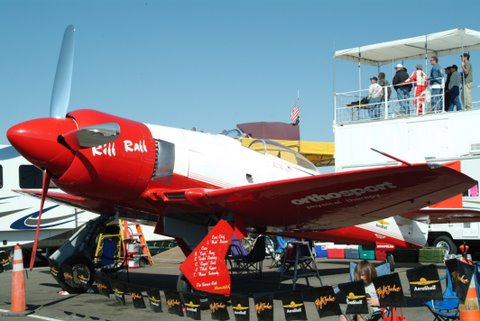
The Unlimited of Choice, The Hawker Sea Fury. These planes were originally powered by a 2500 hp Bristol Centaurus 14 cylinder sleeve valve radial. Those engines are now quite rare so they are re-engined with a Wright R-3350 like this one shown here on the record holding Grumman Bearcat, The Rare Bear...
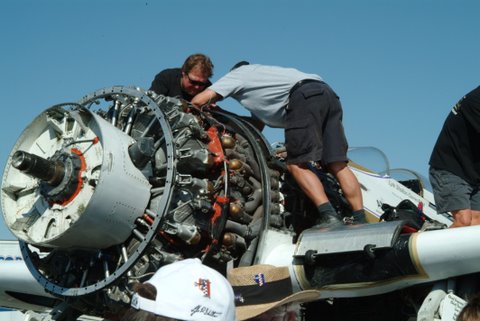
The R-3350 is an 18 cylinder radial that gave 2800 hp in its stock form. In the Rare Bear it is more like 4000 hp.
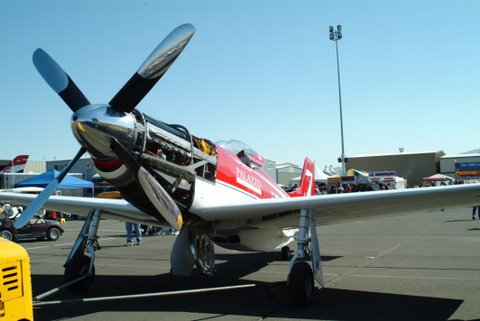
Every pilots favorite, the P-51 Mustang. This one, called Strega has clipped wings and tail, smaller canopy and much attention to detail streamlining.
Strega's power is a Rolls Merlin V-12, about 1700 hp stock, 3000 here.

This is an F2G-1D Super Corsair.
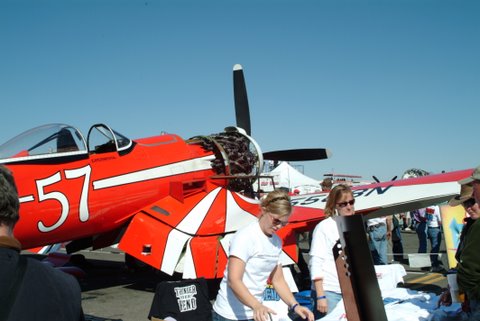
There were only 10 of these built, there are only a few left and this one started racing in the 50's. What sets it apart from the "normal" Corsairs is the engine, which is a Pratt & Whitney R-4360, 28 cylinder "corncob" engine (Most Corsairs were powered by 18 cylinder R-2800's.)

That's 4360 cubic inches, four rows of 7 cylinders, supercharged, 3000 hp. That's stock - this one's been breathed on.
The Super Corsair was getting a new set of plugs- Here they are, about $1000 worth.
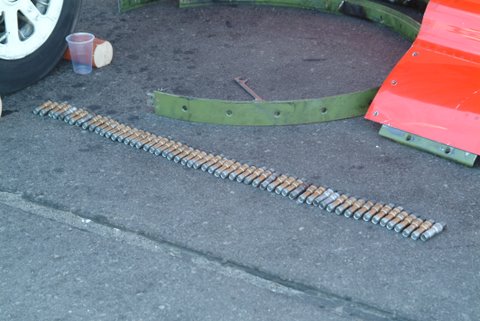
Engines blow regularly. This is where the "Lot's of work and lot's of money spent" part comes in.
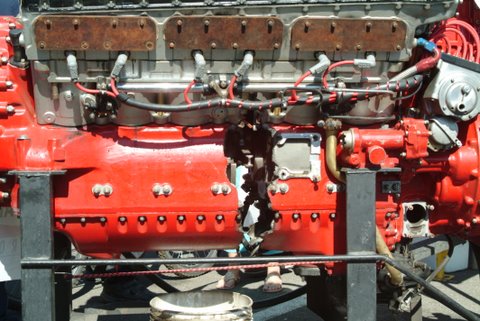
How's this for an expensive noise. This is the Rolls Merlin from a P-51. As you can see, the only thing holding the crankcase together are the heads and cylinders (called "banks" in Merlin -speak).
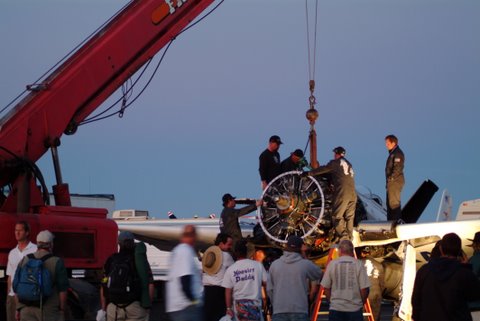
Think working on your bike is lot's of work? Try this for an overnight engine change. Be sure to bring your crane.
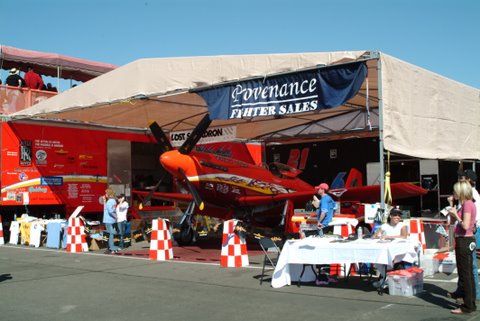
Pit rigs are a job in themselves.
Something to think about-
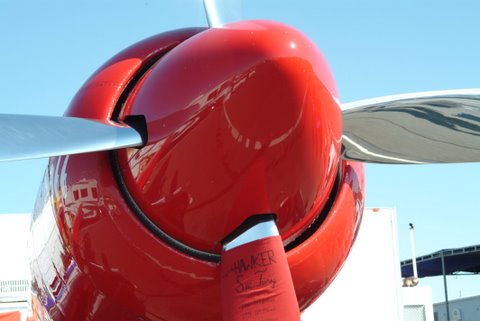
ALL the air required to cool the 3000 hp AIR COOLED R-3350 in this Sea Fury goes in that slot around the prop spinner. Remember, it's the air flow across the engine or through the radiator that counts. Look back at the size of the radiator scoop on the belly of the P-51, Strega.
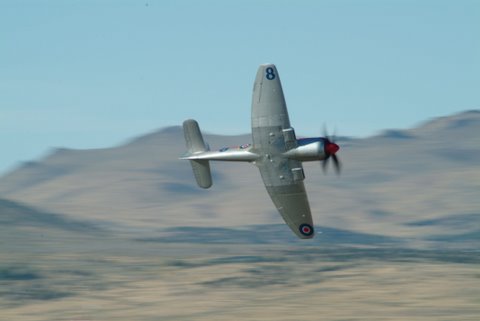
A Sea Fury at speed- 450 mph
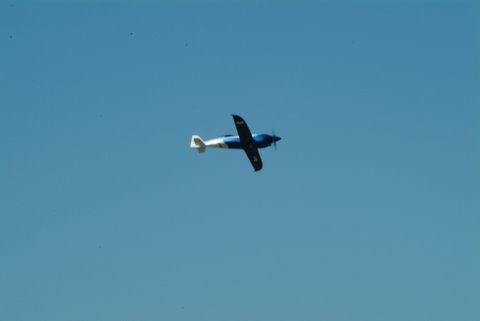
Nemisis- All carbon fiber, 600 hp -350 mph
Posted by Doug @ 23:29 - Permalink - 0 Comments - 0 Trackbacks
Comments
No Comments
TrackBacks
No Trackbacks
THE AUTHOR

Doug Meyer has been working with race engines professionally and as a hobby for the past 45 years. He has built engines for everything from dragbikes and cars to outboard race boats, from the famous Can-Am sports cars and an F-1 car to motorcycle streamliners. He spent many years as a professional race team member and engine builder. Everything from nitrous to nitro, Doug's had his hands in it. He has set 16 Bonneville speed records...
Click here to continue
Click here to continue
RECENT ENTRIES
- The Brits call it an "Off"
- Makin' Stories......
- A Veterans Day Story
- I sold my 1098.... And here's why
- Torque - The question you didn't ask
ArchiveAll photographs by Doug Meyer unless otherwise noted