 |
 HOME HOME |
ARTICLES |
FORUMS |
COLUMNS |
GALLERY |
STORE |
SPONSORS |
CONTACT US |
BRIDGES
A COMMENTARY BY DOUG MEYERTuesday June 27th, 2006
 On Board the Muzzys 240HP Nitrous ZX-14...
I went by the Muzzys pipe shop and found waiting for me a fresh black ZX-14 with a Muzzys exhaust, a Muzzys steering damper, Muzzys frame sliders, and an aluminum bottle mounted where the left passenger footpeg should be. Mounted just below the instrument cluster was a Daytona WEGO II wide band digital air fuel monitor and a new fuel mixture management system Rob will be offering soon. The WEGO II O2 sensor provides a real time A/F readout with a three-hour downloadable memory that can be coded to follow RPM or throttle position. I didn't know that it had memory until later, I hope I didn't do anything that will show up as obviously foolish when he dumps the data.
It had stopped raining just shortly before I pulled out, so I approached my first ride on the world's most powerful production Sportbike with a certain amount of care. I had heard some talk about the super effectiveness of the new Nissen front brakes so I was especially careful with those. I found that bringing the lever in close to the bar helped me modulate the initial grab of the brakes. No worries, they were easily modulated and progressive in the wet and the Bridgestone tires seemed pretty grippy.
The power was also easily modulated and without any unexpected surges. If you really want to find a glitch in power delivery, ride in the wet. Small surges or hesitations in smooth throttle operation become very apparent when you are trying to use very small amounts of very large amounts of available power. I was impressed with the nice delivery at small throttle openings. The dual throttle valves really shine here. Another thing I noticed right away was how incredibly light the 14 felt at slow speeds. Again, ride around city streets on wet pavement and you'll quickly notice a front tire that feels loaded or steering that tends to fall into a turn. I felt a bike that was light, neutral, and stuck to the wet road. I was already excited and couldn't wait for some warm, dry asphalt. It turned out I had to wait a couple days though, so I put the bike in the garage and proceeded to poke around with it a bit.
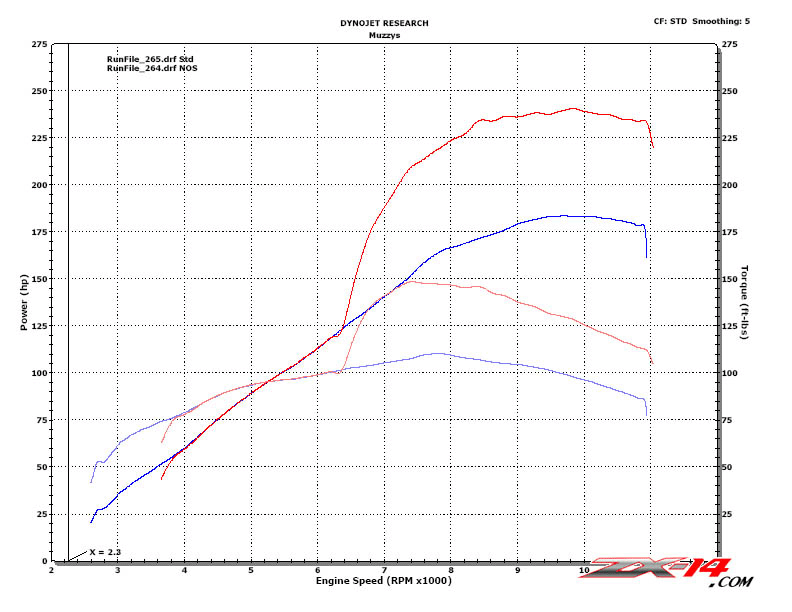
A look at the dyno chart will suggest that there is quite a lot of torque down low that is being "withheld" from the rider by the secondary throttle valves. The inevitable "black box" fix to retime these will undoubtedly supply some eye opening experiences for riders with less a practiced throttle hand. But, just like when CV's were removed in favor of flatsides, driveability will suffer and you'll need to be careful. I suspect that it will be tough to outsmart the computer for more bottom end and still keep the wonderful power delivery this bike offers on the street.

I know the looks of the 14 have been a little controversial, but this black example is, in my opinion, a stunning motorcycle. I liked it at the shows and I liked it even more in my garage. The black and gold steering damper looked great on the steering head and the frame sliders were almost invisible. Later, everywhere I parked the bike, the steering damper drew comments. Much like Muzzy's ZX-12 damper, the setup on this bike bolts on quickly and easily with no drilling or hassle. The Hyperpro HSC damper unit works flawlessly and the assembly looks very cool. Muzzy's solution to the frame slider dilemma is an elegantly simple one with the spool mount bolted directly to the front engine mount with a 180,000 psi ARP bolt, not likely to break. The black Delrin bumper is the only part exposed and they're very unobtrusive. They are effective, too. I know, I tested them. I had the bike on a Baxley Bike Chock (a great tool to have around the garage) and I got careless and pulled it off from the kickstand side. I got a little "over center" and lost it to the high side. (Come on, we've all done it....) The bike hit the floor with a huge CRACK! I dropped an F-bomb that I'm sure was heard throughout the neighborhood. Using my best back saving technique (wheel to the down side, pick up on the bottom handlebar with your back to the bike), I got the bike up quite easily. I was surprised, based on the noise the thing made when it hit the floor. I found not a mark on that beautiful (read: expensive) fairing, nothing except a small crack on the (less expensive) dull black lower, and I'm not sure I didn't cause that when I was picking the bike back up. I'm convinced. My 14 will have these frame sliders.
I suppose that by now you've read what just about every moto-mag has to say about the 14, and it's fairly unanimous that this bike certainly hasn't disappointed anybody. All the National mags have given you the pertinent numbers, so I won't bore you with them. I'll just give you my impression of this bike when used as intended, "on the street".
As soon as I got some dry roads I started riding the black 14 "as intended" and, well, I couldn't stop. This is one of those bikes that, as soon as you get off of it, you want to get right back on it.
Bend, Oregon has become very fond of "roundabouts" (I think there are about 20 of them scattered around, some only a block apart). They are described as an alternative "traffic control device". I think they are excellent chicanes, skid pads and "handling evaluation devices". The first one I encounter when leaving my home is less than a minute away. I usually go in on one side and out the leg on opposite side. When I came in on the 14, the front seemed so incredibly stuck to the pavement I tightened my turn and continued on around, making a full circle, accelerating as I went. The exit required a relatively low speed flick to the opposite side and the quickness of the flip put a grin on my face
I'd been riding this bike on dry pavement for about two minutes and I was amazed. The next roundabout is about a minute away. I started wide, tightened the line and proved to myself that what I was feeling was not a fluke but a predictable characteristic. I think that if a big bike feels good at relatively low speeds, it will be great at high speed, and I wasn't to be disappointed. Who would have thought that you could or would ever call a 1352 cc streetbike "nimble"? That's just what the ZX-14 is though, nimble. I'm fairly sure that everyone who has gotten off of a 12 and ridden one was convinced it was maybe 50 pounds lighter. I would have sworn so, and really had a hard time believing it was almost the same exact weight as the 12. It's all about center of gravity management. KMC engineers succeeded in managing the c.g., chassis geometry, and tire choice so the bike feels like it's just pivoting around a central longitudinal axis. It's very neutral with no tendency to fall into a corner and it's equally neutral when braking into the lean.
I tend to always ride the same roads for comparison purposes and the 14 was easily ridden noticeably quicker than my 12 without any drama. I needed to soften the front a little as it had a bit of a chatter on bumpy corners. The forks responded well to a couple clicks less damping by keeping the front stuck when under power on the exit.
The transmission ratios are perfectly spaced for 2-3-4 squirts between corners and it's awesome fun to accelerate SO hard, ripping through the gears without ever nearing the redline. The close gear ratio spacing is perfect in spite of 6th being an overdrive for cruising. The bike is seemingly always right in the meat of the torque curve. I just LOVE a bike or car that you don't really ride/drive at full throttle very often. The 14 really delivers here. Full throttle is seldom needed. In real world riding, the throttle stops will stay pretty well unused. This bike grabs speed in big 30 mph handfuls. You think your 12 is fast? Your 'Busa?
Well, like I've said before: Fast? You don't know fast.
Even when you ride it lazy like, without even trying - say you just roll into first gear up to 9 grand, maybe 70 mph. Short shift and grab another 30 mph, shift and grab another 30, shift again, and just grab another 30. That takes you to just about 160 doesn't it? It's scary easy to do that, and I'm riding at 3500 feet here.
The only naturally aspirated streetbike I've ever ridden with power like this is my 200 hp 1340cc ZX-12. This ZX-14, with the Muzzys exhaust and a PC3, dynoed at about 180 hp. It's deceptively smooth and speed is effortless, available in any amount you wish to dial up. The stability and composure of this bike at speed is remarkable. And that's a good thing too, because it's awfully hard to be at anything but, "at speed". The dual balancers make the 14 the smoothest motorcycle I've ever ridden. It makes an R-1 feel rough around the edges. The riding position is perfect for me. I have a 150 mile loop through the mountains with a 30 mile stretch on the slab on the way back home. I usually have sore arms when I get home from running the last stretch in a line of 60 mph cages. On the 14 I was perfectly relaxed and had no discomfort whatsoever. It was hard to believe I had ridden as hard as I had for three hours and felt that good.

So, what if we add a 50 hp nitrous shot? Do you ever watch F-1 cars on TV? Or Champ cars on a road course? Hit the button at about 6000 in third (130 mph), the front comes up nicely, about a foot, you gotta' hold on tight, and it sounds like an F-1 car as you thumb the shift button every 2 seconds until you're in 5th , at which time you'd better still be pointed down the road cause you'll be passing 170 mph and very rapidly closing on 180. This is acceleration that very few people get to experience or for that matter, want to experience. Especially on two wheels. Oh, they'll tell you they want to do it, or if they own one of these, they might tell you they do it all the time. But make no mistake, this is serious shit. Every time you do it, it's a big deal. And man, is it fun! The first couple times you do it, you feel like you're going to come flying out the other side of The Stargate. I've not been a big nitrous fan. It's crude, not at all precise, and doesn't take a lot of skill to rig but it's the cheapest thrill in town, that's for sure. I didn't hit it in 2nd, because I wanted to enjoy it, not wrestle with it.
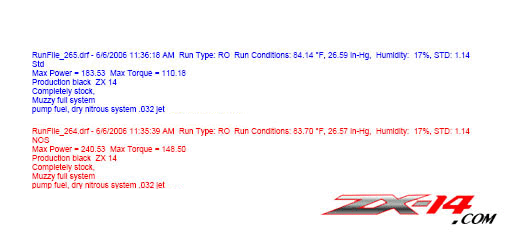
The Muzzys dry kit makes it so easy. The one-pound bottle is good for maybe three or four 50 hp passes like I described. The same bottle runs the "digi-kill" equipped "air" shifter of course, which is solid, incredibly fast and seemingly foolproof. Without the spray, the bottle is good for a few hundred shifts.
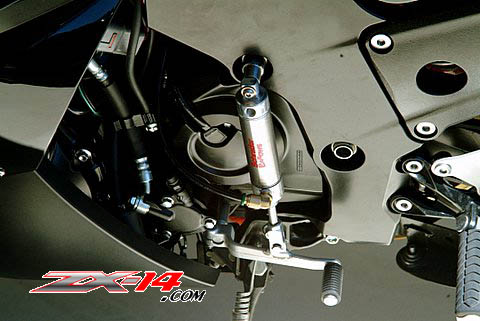
The plumbing is simple, a single jet in a T housing feeding a stainless steel tubing manifold inside the air box (frame) with precision orifice on each side above a pair of inlets. As with the other Muzzys kits, the handlebar mounted toggle switch turns the horn button into the shift button and the starter button into a time machine. The bottle, which mounts in place of the left rear foot peg, comes right off should you want to go back to having the foot peg available for some two up riding, which I did. The bike got a big thumbs up from my riding partner since the 12 is so bad she just won't ride on it with me.
The WEGO wide band A/F sensor/recorder that Muzzys offers is a very effective unit and should save people a lot of money in pistons, head gaskets, etc. It was interesting to see how the A/F readings coincided with what I was feeling in the seat of my pants. Gratifying as well, as what I had felt were lean or rich spots in the mapping were just that, clearly enumerated on the readout and easily addressed with a map adjustment. If you take care and notes, this will enable a lot of home tuners to really get things right. Was that a lean stumble or a rich one? Just look at the numbers and you'll know.
I actually rode this bike twice, initially with a Power Commander and then with the new Muzzys "Digi-Tune". The Digi-Tune offers the use of two maps, one optimized for basic riding (and mods like a pipe) and a switch-able second map that can be written for another engine setup or combination.
As we've come to expect, the PC3 ran quite nicely at low speeds off the juice, but since the mapping was biased to the rich side at higher rpm and throttle openings to accommodate the extra oxygen in the nitrous, you had to contend with a rich situation at those throttle settings when not using the gas. The Digi-Tune certainly worked better with the nitrous since it was able to instantaneously switch between the standard map and the second, richer map when the nitrous button was pressed. The Digi-Tune was spot on for "normal" riding and also provided the correct increase in fuel to up keep things under control when the nitrous was flowing. I never liked forcing the engine to live with the extra oxygen without the fuel in a "dry" kit. This fixes that and makes the dry kit something I would now consider putting on my bike (just for that occasional trip through the Stargate).
Conclusions? Let me put it this way. You know how you feel when you've sort of decided to break up with that woman, but just haven't found the right moment yet? You keep seeing her but your mind is elsewhere, and she just doesn't git'er done for you anymore? Well, I rode my 12 yesterday and sorry girl, but it's over between us. Very soon my once beloved, carefully massaged, 200 mph lime green ZX-12 will be appearing on E-Bay, there will be a spare 1340 cc engine in the Bikeland classifieds, and a black ZX-14 in my garage.
Posted by Doug @ 4:58PM - Permalink - 18 Comments - 0 Trackbacks
Tags: zx14 zx-14
THE AUTHOR

Doug Meyer has been working with race engines professionally and as a hobby for the past 45 years. He has built engines for everything from dragbikes and cars to outboard race boats, from the famous Can-Am sports cars and an F-1 car to motorcycle streamliners. He spent many years as a professional race team member and engine builder. Everything from nitrous to nitro, Doug's had his hands in it. He has set 16 Bonneville speed records...
Click here to continue
Click here to continue
RECENT ENTRIES
- The Brits call it an "Off"
- Makin' Stories......
- A Veterans Day Story
- I sold my 1098.... And here's why
- Torque - The question you didn't ask
ArchiveAll photographs by Doug Meyer unless otherwise noted