 |
 HOME HOME |
ARTICLES |
FORUMS |
COLUMNS |
GALLERY |
STORE |
SPONSORS |
CONTACT US |
BRIDGES
A COMMENTARY BY DOUG MEYERSunday March 19th, 2006
 The Home Depot Frame Check
I loaded the bike up on the lift, stripped the chassis and tires, installed the new forks, and was just about to start working up a set of strings.
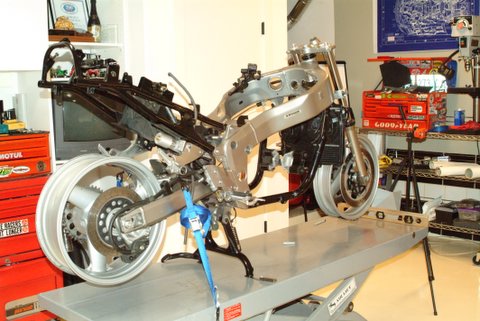
The first step in this process is to see that the bike is level, vertical to the ground. This has to start with leveling the flat surface of the lift. But, as soon as I went to the drawer to grab the level, I had kind of a \"lightbulb\" moment, as my eyes lit upon the $39.95 Black and Decker laser level that I had purchased in the hope that I could hang pictures with only one nail hole in the wall, rather than the usual 3 or 4 it usually took me.
Strings? I don\'t need strings, this is 2006. I have a LASER! Here\'s the process I used. It was accurate, easy, and fun. It took about as long to do it as it will take me type the description of the process.

As I said, first thing is to put the bike on a level surface, then level the bike. No magic here, just put some shim under the center stand as necessary to level the bike. You\'ll need a couple accurate bubble levels, a small one to get into tight areas and a long one to view errors over a longer distance where they become more apparent. I choose to use the engine mount bolts as a reference as they are intended to be perpendicular to the output sprocket and wheels, and parallel to the axles. I take it on faith that they are usually pretty close. After leveling the lift with shims, I needed about 2mm under the right leg of the side stand to get the bubble in the center of the level on the top rear engine mount bolt.
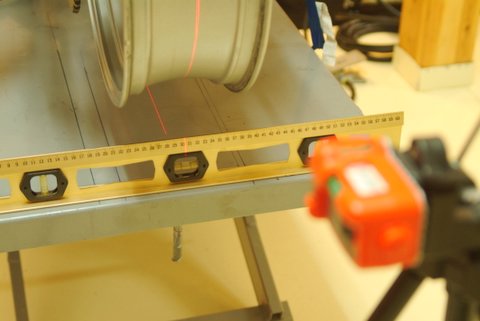
Then, with the laser level on a (camera) tripod, and turned to the vertical mode, I leveled the laser which put the red light line exactly vertical. As I positioned the laser onto the rear of the rear brake disk-presto, the laser line was exactly on the edge of the disk, verifying that the bike was vertical. This shows that the swing arm was not \"tweaked\", because if it was, the disk would not have been vertical.
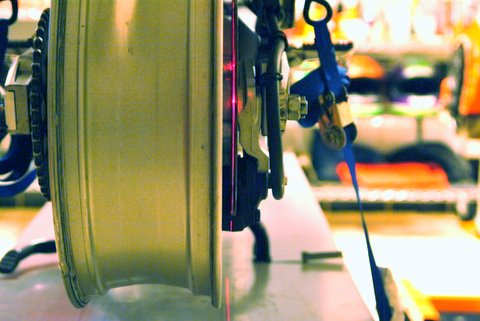
At this point I spun the rear wheel against a dial indicator to determine if it was bent. It wasn\'t, so next I used the laser to create a box around the wheels, just as I would have done with strings, only it was much easier with the laser. Remember, the rear wheel is verified as vertical, so by taking an accurate straight edge and placing its\' edge against each side of the rear wheel at two vertical points at the front side edge and two at the rear side edge, I can end up with four points drawn on the work stand, two on each side of the rear wheel. It\\\\\\\'s easy then, to put the laser line on these points and, using a marker, draw line on the work surface. This line is the \"string\".

In the course of this part of the exercise I learned that the stock chain marks are about 1/2 a graduation off on the right side.
Those laser \"string\" lines are extended forward on either side of the front wheel, and in the same manner as on the rear, again using the inside edge of the vertical straight edge, I was able to center the front wheel by adjusting until I have equal distances on each side, fore and aft, between the guide lines drawn on the work stand.


The next thing I need is a centerline reference underneath the bike. Back in pre-LASER times, I would have taken the calipers and measuring from each outside edge of the front and rear rims I would have found the center of the rim and hung a plumb bob in a string off the rims to a point on the work surface below. The resulting point should be halfway between the previously drawn marks made from the wheel rim edges. You should be able to stretch a string or draw a line straight under the bike, and the centers of both wheels should fall in line. If they don\\\'t the frame has a \"bend in the middle\".
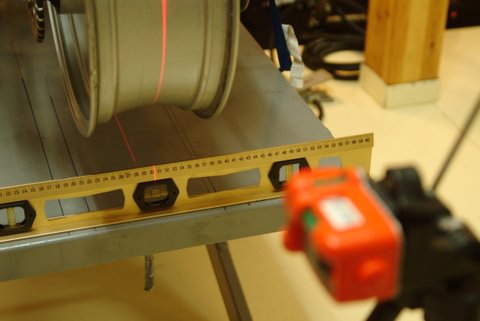
Moving around to the front, I checked the horizontal true of the front wheel/fork assembly by putting the 24\" level on top of the front wheel and, with the laser level in the horizontal mode and leveled, placed the laser line on the edge of the level. The proof of the whole assembly being true is the laser line running true over the 24\" length of the level.

Now, here is the REALLY cool part of this deal, something you just could not do with the strings. By rotating the laser level back to the vertical mode, and by putting the laser line right on the front wheel\'s centerline scribe marks, you can follow the vertical line from the centerline on the work surface, up through the center of the front wheel, and all the way up to the top of the steering head. Any misalignment of the front forks or \"twist\" in the steering head would stick out here like a Canadian in Florida. Look closely at the photo and you can see the laser line run right along the machined surface of the front fairing mount boss.


So there you have it. Hi-tech laser frame checking in your garage for less than 50 bucks! If something happens and you need to check your frame, just to be sure if it\'s hurt or not, it\'s now easier than ever.
Posted by Doug @ 11:20PM - Permalink - 3 Comments - 0 Trackbacks
Tags: motorcycles
Tuesday December 13th, 2005
My name is Doug and I'm.....I realized that at least once a day I have the desire to buy a motorcycle. I keep it under control (well sort of) by consciously saying to myself everyday "Today I will NOT buy a motorcycle." It seems to work for 363 or so days a year.
I got away clean this time, but that doesn't mean I came home with fewer motorcycles than I had when I arrived in Seattle. I actually came prepared to take a bike home with me, courtesy of board-member, swft. He had a ZZR-1200 rolling chassis and well, I have an engine. So on Sunday, before I left town, we connected and I had the chassis in the truck. By next spring I will have added a ZZR-1200 (well a 1224 probably) to the stable. This is important because I need a motorcycle that comfortably seats two, something I don't usually have. Did I say need? Well, yes I did. Some people would argue that. They would say nobody needs a motorcycle, let alone several. But it is a need, maybe one we've created ourselves by repeated exposure to the adrenalin and joy of riding, but make no mistake all you non riders , it IS a need.
There were two outstanding offerings at the show. It will be a miracle if I don't by one of these within the next year. I don't have a V-twin. I've never had a V-twin. I need a V-twin.
(I had a V-4once, but that\'s different, and it was a horrendous piece of crap Interceptor that I couldn't get rid of fast enough. Leaving my garage was the ONLY thing that bike ever did fast.)
More to the point,
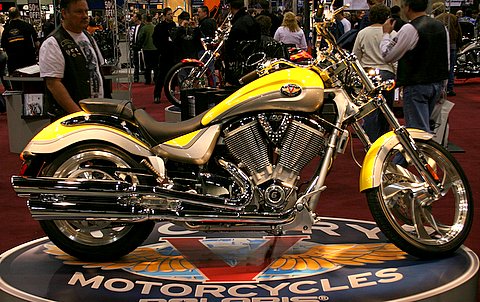
I think the Victory Vegas is a stunning motorcycle. The Ness styling is apparent and the engine is art. And they run pretty well too. A few years ago, I was a guest tester for Jamie Elvidge and the crew at Cruiser Magazine where we tested 14 big bore cruisers for a big shootout article. One was a Victory and I picked it as the best engine of the group. It was a torquey 92 incher that was smooth and willing to rev. It made an otherwise unimpressive motorcycle impressive. I'm looking forward to getting a chance to ride one of the new 100 inch Freedom engines this spring. I love the looks of this yellow bike!
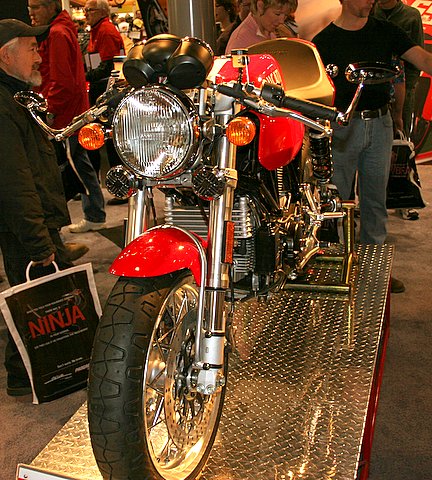
The next thing that got me interested at the show was the new Ducati 1000 Sport. Now, I'm not usually a fan of replicas or re-makes. I especially don't believe they are worth the premium paid for the special color or signature. This Duck though, has a perfect look for me. I had an '81 900 Dharma SS that is one of my all time favorites and the desire for things Ducati has never left me. I'm always on the lookout for an old one, but this red sport has that look, no matter what it's vintage. It's a two valve 1000, about 100hp and pretty light. I'll be testing one of these when the roads clear as well. I need a Ducati.
So, I'm only back from the show a couple days and I get this call. It seems that a 2002 turbo 12 that Muzzy's had built a couple years ago for Mike Corbin to take to Bonnevile was no longer needed by the Corbin crew and was for sale. After it went 220mph on 11 pounds of boost ("World's Fastest Bagger"), I had offered to buy it from Mike, but the offer was declined. Apparently he still needed it. He called. "Did I still want it?", he asked. "Uh, yeah" said I, now in some form of stimulus /response mode. The price was too good to pass up (they always are, aren't they?) and now THAT bike is on the way. I don't know what form it will take when I'm done with it - Bonneville bike? Godawful fast street bike? I don't know, I guess I just need a 400 hp motorcycle.
You might be thinking "What about the 14?" Well, I'm going to work on that. I do sort of feel the need to own one.
Posted by Doug @ 11:40AM - Permalink - 0 Comments - 0 Trackbacks
Tags: motorcycles
Sunday November 20th, 2005
My kind of guy.....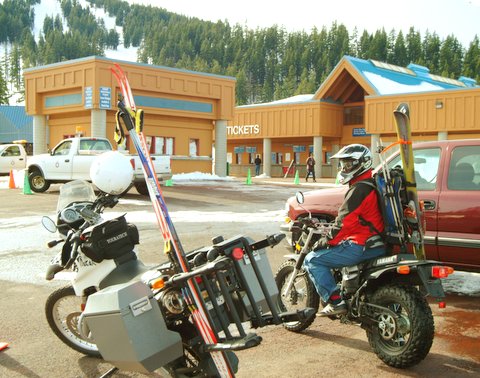
This is Mike Eizel from Bend, OR. I told him I\\\'d like to post his photo and explained who I was and about Bikeland. He didn\\\'t know anyhting about such things since, he explained, this is his first bike. I think we\\\'ve got the makings of a hardcore here. Way to go, Mike.
Posted by Doug @ 11:09PM - Permalink - 0 Comments - 0 Trackbacks
Tags: motorcycles skiing
Wednesday October 26th, 2005
The best commercial you didn't see.Novel, no? Maybe, but not original. It's been done before, but you didn't get to see it.
When the Kawasaki new models are introduced to the dealer network every year at "The Dealer Show", part of the routine is a debut of all the upcoming TV, radio and print advertising that the ad agency has come up with. The assembled dealer body and guests (maybe 2000 or so people) sit in an auditorium and watch and listen. The good ones are cheered and applauded for dutifully.
In 2000 Kawasaki USA debuted what was one of the best TV commercials ever for a modern motorcycle. I don't remember the details but I'll give you the gist of it:
In a large, nearly dark, urban parking garage the sound of a couple mean sport bikes can be heard getting closer and closer to a meeting. Coming up a ramp, headlights appear and they belong to a non specific brand of motorcycle that just might have looked like a Hayabusa. Around the opposite corner come the unmistakable alien headlights of the new ZX-12R. The UJS stops in its' tracks. The ZX-12 advances and stops. Throttles rev, first one then the other, then the 12 again. The camera switches back and forth from one bike to the other as the tension of the standoff builds. The ZX-12 revs one more time and then the camera stops on the anonymous UJS in time to hear its' revs fall and all the oil spill out the bottom of the fairing and onto the stained concrete floor, as it wets all over itself in fear. This followed by a powerful voice over exclaiming the new ZX-12 as the new king or some such.
Well, you might imagine that this commercial was genuinely greeted with cheers and resounding applause and it certainly was. It was one bad ass commercial and everyone loved it. The dealers loved it. The KMC execs loved it. The guests and press loved it. So why didn't you see it? SOMEBODY didn't love it.
From what I heard the commercial was produced in the US by KMC USA's agency without approval or involvement by the Japanese, (I think this is usually the case) and THEY didn't love it at all. As a matter of fact, it was never to be shown again. The people who had worked on that spot were severely pissed and there was a great deal of discussion and consternation all around. Matters of taste between societies are delicate matters and apparently this commercial was considered in bad taste (which is nothing short of astounding if you've ever seen a Japanese game show) by the Japanese hierarchy, and they are after all, the boss.
In my opinion this was just one more aspect of the most mismanaged product release this industry has ever seen.
Too bad, you\'d have loved it.
Posted by Doug @ 7:35PM - Permalink - 1 Comments - 0 Trackbacks
Tags: motorcycles tv
Sunday October 16th, 2005
The Green BikeThis is the first year of what has become the KLR-650/KLX family, for the most part an acknowledged slug of a bike. They're too heavy to ride in the dirt, too uncomfortable to go very far on, too slow to thrill, and so hard to start that the second year they went electric. But mine, which has become known by me and my riding friends as "The Green Bike" has risen above all that so much so that every time I ride it I say to myself "I'll never sell this thing."
Actually I should say I'll never sell this thing again, because I did sell it once and missed it so much I bought it back. I took this bike in on trade in 1985 one year after it was first sold. It was kind of a (literally) white elephant. It would frustrate me with it's reluctance to start and it was pretty ugly and no one wanted to buy it, but it was always around and I found my self jumping on it whenever I had to just run someplace. I found that it was just the thing to split lanes in San Francisco area traffic and in general just to get somewhere with a minimum of fuss.
The starting thing needed to be addressed though, and the key was simply a better coil and plug wire. To this day if it takes more than three kicks to fire, it's out of gas. Next, it needed more power (I think everything needs more power) so the stock CV carb was replaced with a 36mm round slide Mikuni and that heavy muffler got tossed for a Supertrapp. By this time the bike had my interest and attention - kind of like the plain girl you've been taking for granted that all of a sudden gives you that look.
One Sunday I took it on "The Sunday Morning Ride", well known as THE Sunday morning ride up Highway 1 north of San Francisco. This was an eye opener. I learned that a 21" front wheel with a universal tire can stick really well and that unlimited ground clearance can yield quite a cornering speed. Thereafter, on went the flat handlebars and the good pads with the braided brake line.
I found that KLRs in Canada were sold in the familiar Kawasaki Lime green, so I secured from our friends at Burnaby a complete set of green bodywork and it became "The Green Bike". By this time it was 1987 and I, along with a few other crazies, decided that we needed to race in the La Carrera Classic road race in Mexico. This race is (was) probably the first of what have become known as "open road" top speed races, it being run from Ensenada to San Filipe, across Baja on Mexico Highway 1, as fast as you can go-flat out something like 115 miles. This race was restricted to singles, twins, and vintage race bikes and The Green Bike was going to run it.
Time for more power. The cylinder was cut, the head ported and clipped and the cams were re-timed. I found that in Germany, Metzler sold a 21" laser front tire and put one on along with a ME99 sport rear. The Green Bike would now go somewhere north of 110 mph in a full tuck with some fairly tall gearing.
Nick Ienatch was entered on a bumblebee black and yellow GS BMW and we diced for tens of miles I was faster on the straights, he in the corners. The speedometer broke coming down the long hill into the pit stop at Independencia indicating 125 mph with the tach needle hard in the red at over 8 grand. That speedometer still sits at 6700 miles, as it was on that day 18 years ago. I finished, I think, 11th in the singles class, averaging something like 90 mph, but it didn't matter. That race, that day, was one of the most fun days on a bike I've ever had- and on that slug of a 600 single.
The Green Bike continued to go out on many Sunday mornings and became a regular sight as my pit bike on the Bonneville Salt Flats. I fell off the bike only once, that during a heated engines-off coasting race down from the top of Mount Tamalpais one Easter Sunday morning (It was a coasting, after all, and you just can't afford touch the brake). When I moved to Oregon in 1995 I sold The Green Bike to Jamie Wiliams, the local Kawasaki District Manager. I think he saw how much I liked her and wanted to see why for himself.
Shortly thereafter I bought a KTM Duke which was cool, but just didn't fit like the KLR, so I called Jamie and, even though he had had her for about 4 years, I offered him what he had paid me to sell it back. We met at a race and the KLR was back in my hands. And still is, which is why, when I wanted to go for a ride today, this beautiful fall afternoon in October 2005, about 20 years after I got it, I jumped on The Green Bike.

Posted by Doug @ 7:39PM - Permalink - 0 Comments - 0 Trackbacks
Tags: motorcycles
Friday October 7th, 2005
Fast? You don't KNOW fast. Sometimes I wonder if most of us really appreciate exactly what we have here. We jump on our ZX-12 or 10 or Hayabusa or whatever our two wheeled choice may be and we roll on out. Most of the time, we just use whatever throttle we need to stay civil, but occasionally we throw in a little stab here and there just to tickle the tiger. When the opportunity arises, we grab a full handful and within 10 seconds or so we're going 150, 160 mph. If it feels right, we hang on a bit longer and within 20 seconds we've reached speeds greater than all but about a half a dozen four wheeled types could ever muster. We don't exactly take this for granted.
 The experience is, after all, intoxicating, and we do keep coming back for more and always want even more than that. But the uniqueness of this access to velocity was brought home to me two years ago when I bought the Corvette I'd wanted for so long, ever since I had sold my second Corvette, a '65 roadster, which I had let go after 20 years in 1984. The '65 was virtual racecar, originally a 365 hp. 327, with factory side pipes, 4:11 gears and a close ratio gearbox. I had further massaged it into what was, arguably, one of the fastest cars on the Chicago area streets where I grew up. The bikes I had during that time, especially my first Bonneville record bike (156 mph, in 1976) which was a highly modified Z-1, were no match for the 'Vette. But after that, starting with my '84 Ninja 900, the bikes just kept getting faster and faster and the cars seemed to fall by the wayside.
The desire for a fast car re-surfaced and became something I could achieve in 2004. I wanted another Vette and the fastest of them all at that time was the Z06 option, which like the '65, is a racecar for the street. Lighter than the "normal" Corvettes at 3150 pounds, with 405 hp, close ratio six speed, big brakes, all the good stuff. Heck, it even has a special ($3000 if you break it) thin glass windshield for lighter weight.
So, it was with great disappointment when I found that, the first time I really nailed it, that it was, well, kinda' slow. Not car guy slow, mind you, but definitely BIKE GUY slow. Although capable (under good conditions and if driven well) of a high 11second quarter mile time, it just seemed lazy. Now, I couldn't say that to anyone. What kind of an idiot would say his Z06 was a pig? Not politically correct in the car world, for sure. But I was really disappointed.
Things then took their natural course (for me, anyway) and on went the stainless long tube headers, the cold air ram inlet, the cooler thermostat, the full LS1 computer re-tune, the Motul oil, etc. which now gets us to about 440 hp. This is a FAST car. It rips. It scares people that I take for rides. I have to brief them. I say "Now, what we're about to do will frighten you. But trust me, I'm not going to hurt you. It'll be fun." The girls actually scream sometimes.
The guys say " Man this thing is FAST!"
And I say, thinking about my ZX-12R or the last Turbo I rode,
"Fast? Dude, you don't KNOW fast!"
Posted by Doug @ 6:27PM - Permalink - 0 Comments - 0 Trackbacks
Tags: motorcycles speed
THE AUTHOR

Doug Meyer has been working with race engines professionally and as a hobby for the past 45 years. He has built engines for everything from dragbikes and cars to outboard race boats, from the famous Can-Am sports cars and an F-1 car to motorcycle streamliners. He spent many years as a professional race team member and engine builder. Everything from nitrous to nitro, Doug's had his hands in it. He has set 16 Bonneville speed records...
Click here to continue
Click here to continue
RECENT ENTRIES
- The Brits call it an "Off"
- Makin' Stories......
- A Veterans Day Story
- I sold my 1098.... And here's why
- Torque - The question you didn't ask
ArchiveAll photographs by Doug Meyer unless otherwise noted